REVIEW · AUDIO TOURS
800 Years of History: A Munich GPS Audio Tour
Book on Viator →Operated by VoiceMap Audio Tours · Bookable on Viator
Munich history has a GPS breadcrumb trail. This English audio walk threads together major landmarks from Marienplatz out toward Frauenkirche, with narration built for stop-and-go wandering instead of rigid group pacing. You can start when you’re ready, pause when hunger hits, and keep the tour for the long run.
What I love most is the self-paced stop-and-restart style. You’re not stuck with one speed, and you can pop into a market moment or step back to read the stonework without feeling rushed. Second, the included offline audio, maps, and geodata make it reliable even if your phone reception is spotty.
One thing to consider: if there’s temporary construction or a large, confusing square, the route can feel a little harder to follow than you’d expect. The good news is that the on-screen map and your live location help you reorient quickly.
In This Review
- Key things to know before you go
- Munich GPS Audio Tour: what you really get for $9.99
- Getting started at Marienplatz: the smartest base for a first evening
- Marienplatz to St. Peters Church: learn the square before you chase details
- Viktualienmarkt and Honighäusl: turn history into a snack break
- Hofbräuhaus and Alter Hof: beer-hall fame with older roots
- Max Joseph Platz, Residenz, and Feldherrnhalle: a stretch of major monuments
- Theatine Church, Palais Holnstein, and the “spot it” moments
- Frauenkirche and Frauenplatz: the finish that gives you closure
- Price and value: does $9.99 make sense for a one-hour walk?
- How to use it well: headphone, battery, and route tips
- Who this Munich GPS audio tour is best for
- Should you book this Munich GPS Audio Tour?
- FAQ
- How long is the 800 Years of History: A Munich GPS Audio Tour?
- What language is the audio tour in?
- Where does the tour start and end?
- Is the tour self-paced?
- Does it work offline?
- What app do I need?
- What should I bring with me?
- Can I cancel for a full refund?
Key things to know before you go
- Offline VoiceMap means audio and maps can keep working without constant data.
- Live GPS guidance on your screen helps you stay oriented through squares and turns.
- Stop and start anytime so you can shop, snack, and reset your pace.
- Marienplatz to Frauenkirche loop covers the most iconic Munich sights in one walk.
- Private to your group setup means you won’t be pulled along by strangers.
- Lifetime access gives you a do-over later, not just a one-night ticket.
Munich GPS Audio Tour: what you really get for $9.99
For under $10, you’re buying a guided walking route plus a learning layer. That’s the key value here. You’re not paying for a person to lead you step-by-step. You’re paying for a route that explains what you’re seeing, when you’re standing right there, with GPS help so you don’t have to constantly consult your map.
The format is VoiceMap through a smartphone (Android or iOS). Once you download and start, you follow prompts on your screen. When you reach a stop, the audio moves you along. When you pause, it pauses. That matters because Munich rewards slow looking—church façades, square geometry, market corners—stuff you miss when you’re rushing with a group.
The time range is about 1 hour 10 minutes to 1 hour 30 minutes, depending on how long you linger. In practical terms, it fits perfectly as an early evening orientation walk, or as a “hit the highlights” plan on a day when you’ve got museum time later.
You can also read our reviews of more historical tours in Munich

Getting started at Marienplatz: the smartest base for a first evening
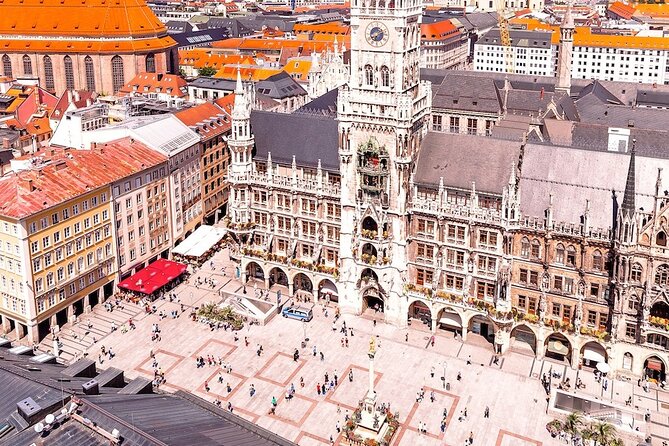
The walk begins at Marienplatz (80331 München-Altstadt-Lehel). This is a good choice because it’s central and it keeps you close to lots of transit options and “what do we do next?” energy.
Here’s the practical trick: before you press play, take a few seconds to set yourself up.
- Plug in headphones (if you’re bringing them) and set a comfortable volume.
- Open the VoiceMap experience so the offline maps are loaded.
- Start walking with your screen glanceable, not buried in your bag.
Marienplatz is one of those big-city squares where directions can feel tricky if you’re staring at your phone and dodging people. The on-screen location map helps, and it’s your best friend if you hit temporary route changes due to street work.
Marienplatz to St. Peters Church: learn the square before you chase details
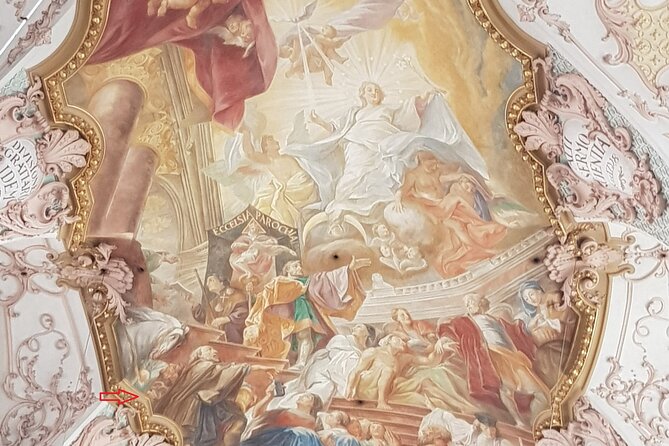
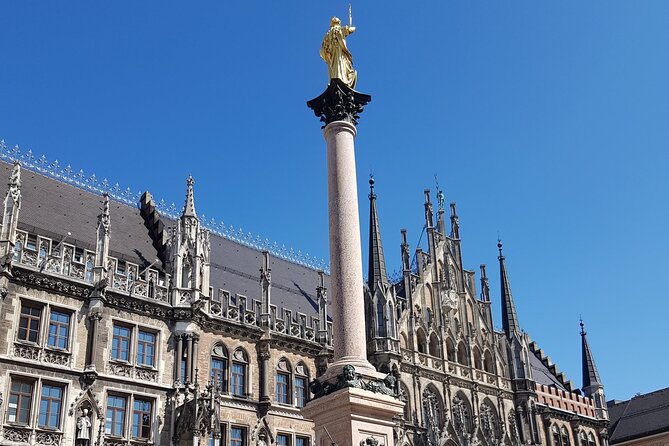
From Marienplatz, the route heads past St. Peter’s Church. This is where the narration style starts to make sense: rather than lecturing, it gives you just enough context to connect the building you’re looking at with Munich’s bigger story.
I like this portion because it’s early enough in the walk that you’re still mentally fresh. You’re learning how to interpret the city as you go. And since it’s a self-guided experience, you can stop for a better viewing angle without messing up the rest of the route.
If you’re the kind of traveler who usually skips audio tours because you’re worried they’ll be too slow, this segment is a good test drive. You get the rhythm fast: walk, listen, look, move on.
Viktualienmarkt and Honighäusl: turn history into a snack break
Next you pass through Viktualienmarkt. This is a high-reward area because markets are both sightseeing and real life. The tour’s pacing works well here: you can pause the audio to browse, refill your energy, and continue when you’re ready.
You’ll also encounter Honighäusl, which adds a fun, local-feeling stop in the middle of the walking route. The sweet spot (literally) is that these pauses make the history feel less like school and more like wandering.
A tip I’d give: if you’re planning to snack, do it during the market section. That’s when the “pause whenever you want” design is most useful, and you’ll feel less rushed later in the walk.
Hofbräuhaus and Alter Hof: beer-hall fame with older roots
The tour then passes by Hofbräuhaus and stops briefly in Alter Hof. This combo is smart. Hofbräuhaus brings the famous Munich beer-hall identity into your line of sight, while Alter Hof gives you a cue that the city’s story goes back farther than any single attraction.
This part of the route is also where timing helps. If you’re walking in the early evening, you can work in a quick break without turning the whole day into a slow shuffle. If you’re walking later, the landmarks are still worth it, but you may want to plan your pause strategically so you don’t end up spending the whole walk at the first tempting stop.
The narration approach keeps moving, but the self-paced controls let you choose how long you stay connected to what you’re hearing.
You can also read our reviews of more tours and experiences in Munich




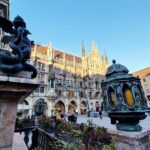
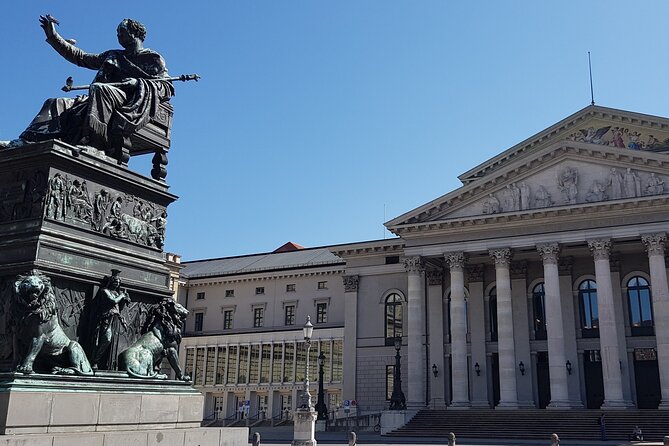
Max Joseph Platz, Residenz, and Feldherrnhalle: a stretch of major monuments
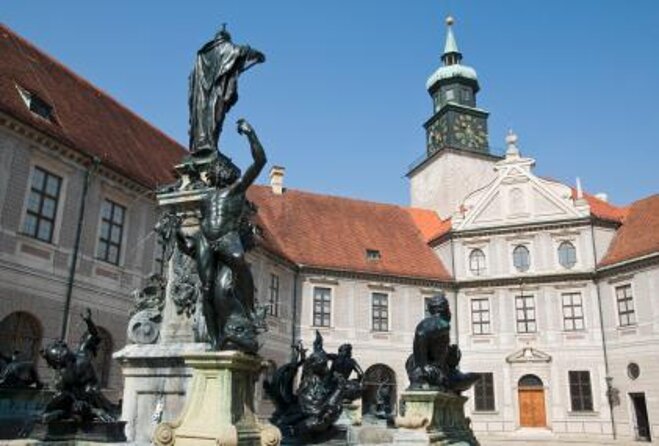
As you move onward, you pass through Max Joseph Platz, then Residenz, and by Feldherrnhalle. This is the “big architecture and political symbolism” zone—less about quick snacks, more about landmarks that make Munich feel like a capital city.
What’s useful is how the audio tour frames these stops as connected points across time. You’re not just looking at buildings; you’re learning why these places mattered enough to show up repeatedly in the city’s story.
One caution: this section includes wide, formal spaces. If your phone signal is bad (or your battery is low), that’s exactly where having offline maps helps keep you oriented. Keep an eye on the route line and your dot on the map. It’s the easiest way to avoid wandering when you’re surrounded by grand-looking streets.
Theatine Church, Palais Holnstein, and the “spot it” moments
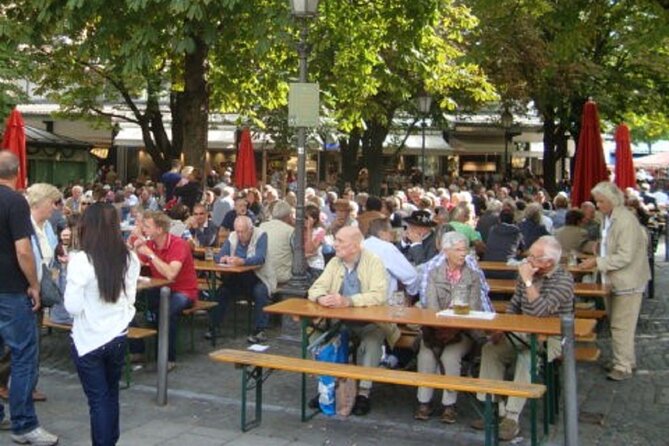
After Feldherrnhalle, you pass by the Theatine Church and Palais Holnstein. Then the route heads toward Frauenkirche later, but I’d treat this middle-to-late segment like a treasure hunt.
One small detail to watch for: there’s a fun kind of listening/looking payoff if you notice specific motifs in church artwork. The tour experience includes at least one moment where a pretzel detail shows up in church fresco context. You won’t need to memorize it—just know that the audio sometimes points you toward specific things to spot while you’re standing there.
If you like practical sightseeing—learn one thing, then go look for it—this is the part of the walk where that style clicks.
Frauenkirche and Frauenplatz: the finish that gives you closure
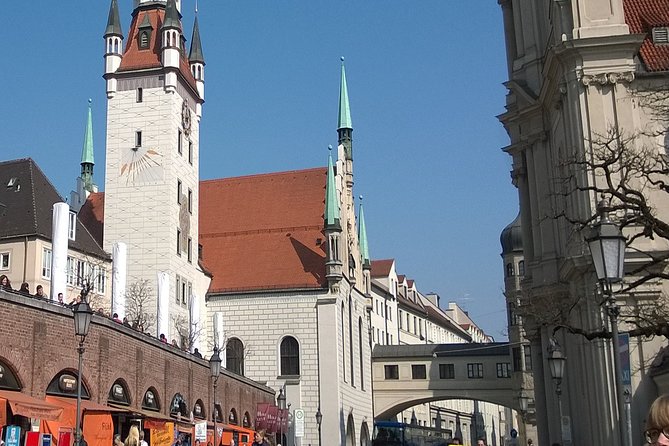
The walk passes by Frauenkirche and goes through Frauenplatz, ending back at the starting point on Marienplatz. Ending at a major hub is ideal because you’re not stuck thinking about transit logistics right at the end of a walk.
Frauenkirche is the kind of landmark that’s hard to ignore, and Frauenplatz helps you transition from “listening mode” to “okay, I get this city now” mode. This is a satisfying end because you’ve covered a loop of major sights without needing a complicated plan.
If you still have energy, I’d use the final minutes to do something simple: walk a little slower and re-look at what you saw earlier. The point of a self-paced history walk is that it trains your eyes. By the end, you start noticing patterns—square layouts, church locations, and how the city’s centers connect.
Price and value: does $9.99 make sense for a one-hour walk?
At $9.99 per person, this is positioned as a value buy. The main reason it can be worth it is the mix of:
- Lifetime access, so you can repeat it later or use it on a future trip.
- Offline access to audio, maps, and geodata, which protects your experience from unreliable connectivity.
- English narration, so you don’t need to rely on translation apps.
- A route that hits multiple headline stops in about 1.5 hours.
If you only have one evening and you want a structured way to see Munich’s central highlights, this beats wandering without context. If you’re a hardcore researcher who wants deep scholarly detail for every monument, a self-guided GPS audio tour may feel too general. But for most first-timers, “enough context in the right places” is exactly the sweet spot.
For me, the best part is not paying for a guide’s time. You’re paying for a tool you can use at your speed, and that usually makes the experience feel more personal, even without a live person talking to you.
How to use it well: headphone, battery, and route tips
This is easy tech, but a few habits make it smoother.
- Bring headphones if you have them. The tour does not include them, and you’ll want private audio while walking.
- Keep your phone charged. Offline maps still use power, and GPS navigation can drain faster than you expect.
- Glance at the live map when you see a wide square ahead. It’s your quick orientation fix if you’re unsure which way to go.
- If you hit a detour or construction, don’t panic. Pause, check your dot, then continue once your route line makes sense again.
Also: don’t over-schedule right before and after. Even though it’s self-paced, you’ll enjoy it more when you’re not rushing to catch a bus or squeeze in another timed activity.
Who this Munich GPS audio tour is best for
This works especially well if you:
- Want a first-evening orientation around the center of Munich.
- Prefer flexible timing over group coordination.
- Like learning while walking, not just staring at a plaque.
- Appreciate offline-friendly travel tools.
It may be less ideal if you:
- Want constant interaction with a live guide.
- Get frustrated by smartphone-based navigation.
- Need very detailed, academic-level commentary at every stop.
Because it’s also listed as private to your group, it’s a nice option for friends or families who want their own pace without the awkwardness of matching a stranger’s walking speed.
Should you book this Munich GPS Audio Tour?
If you’re looking for a simple, low-cost way to connect the big sights—Marienplatz, key churches, market time, Hofbräuhaus, and the walk toward Frauenkirche—then yes, it’s a smart buy. The offline VoiceMap setup is a practical advantage, and the stop-and-start control is exactly what makes a walking history tour feel comfortable.
I’d only skip it if you’re picky about navigation and hate smartphone guidance, or if you specifically want a live expert to answer questions on the spot. If you can tolerate a little screen time, this is an efficient way to get your bearings and learn Munich at a pace you control.
FAQ
How long is the 800 Years of History: A Munich GPS Audio Tour?
It usually takes about 1 hour 10 minutes to 1 hour 30 minutes.
What language is the audio tour in?
The tour is offered in English.
Where does the tour start and end?
It starts at Marienplatz, 80331 München-Altstadt-Lehel, Germany and ends back at the same meeting point.
Is the tour self-paced?
Yes. You can stop and start as you like and continue later, with lifetime access.
Does it work offline?
Yes. Offline access to audio, maps, and geodata is included.
What app do I need?
You use the VoiceMap app on Android and iOS.
What should I bring with me?
You’ll need your smartphone and headphones (not included).
Can I cancel for a full refund?
Yes. Free cancellation is available up to 24 hours in advance for a full refund.
If you want, tell me when you’ll be walking (morning, afternoon, evening). I can suggest a pacing plan so you hit the best “pause and look” moments without running out of daylight.