REVIEW · SELF-GUIDED TOURS
Ghosts of Munich: The Haunted Apprentice Exploration Game
Book on Viator →Operated by Questo · Bookable on Viator
A haunted route with no lines at all. This self-guided game turns central Munich into a walking story, with offline audio you can use without mobile data surprises. You’ll solve challenges at major landmarks like Odeonsplatz, Frauenkirche, and Marienplatz, all at your own pace.
I especially like the flexibility: start when you want, pause for breaks, and resume later. The price is also hard to beat for a 1–2 hour plan that includes the audio part and avoids a physical guide. One drawback to consider: a few stops involve admission not included, so you’ll want a little extra cash if you plan to go inside.
In This Review
- Key highlights and what they mean for you
- Ghosts of Munich: a haunted puzzle route you can do on your schedule
- Price and value: paying $7.21 for a flexible 1–2 hour plan
- How the offline game works (and why you don’t need a guide)
- Start at Odeonsplatz: Leo von Klenze’s Italian-style square and a 1921 clash
- Hofgarten: a 17th-century Renaissance garden with a side of secrets
- Theatinerkirche St. Kajetan: white interior, yellow facade, and a clue you earn
- Sitzender Keiler (Sitting Boar): rub the nose, then solve the mystery
- Frauenkirche: twin towers near 100 meters and the Devil’s footprint legend
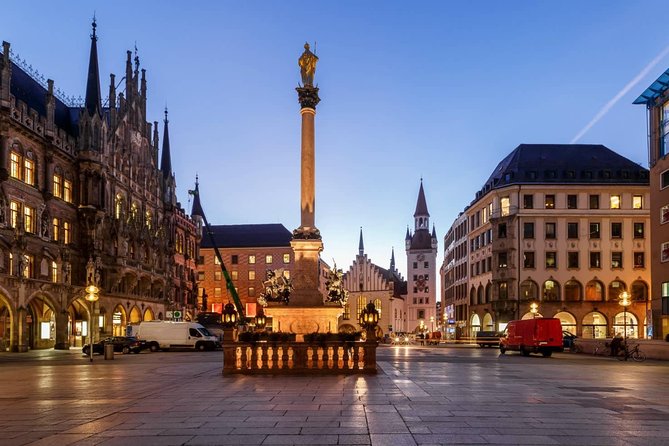
- Marienplatz: Munich’s central square where stories and schedules overlap
- St. Peter’s Church and its 299 steps: Munich’s oldest church
- New Town Hall (Neus Rathaus): Glockenspiel stories and a dance-style final clue
- Timing, walking pace, and making it feel like your trip
- Who should book this game (and who might prefer something else)
- Should you book Ghosts of Munich?
- FAQ
- How much does Ghosts of Munich cost per person?
- How long does the experience take?
- Can I use the game offline?
- What language is the game offered in?
- Do I need to go with a guide?
- Where do I start and where does it end?
- Are tickets included for all stops?
- Can we start at any time and take breaks?
- What if I need to cancel?
Key highlights and what they mean for you
- Offline-friendly audio means fewer worries about phone data charges while you’re walking.
- Start any hour, pause anytime so you can match the route to your energy and weather.
- Private group play keeps the experience calmer and more self-paced than big guided tours.
- Munich landmarks built into the story (churches, squares, and the New Town Hall) make it easy to combine with sightseeing.
- Some locations charge separately for entry, so read as you go and budget for it.
Ghosts of Munich: a haunted puzzle route you can do on your schedule
If you like your city time light on lectures and heavy on clues, this game fits nicely. You’re not just walking past landmarks—you’re stopping where the story says something is about to happen, then answering questions that tie the locations together.
What makes it feel different is the mix of well-known Munich sights with a spooky angle. Odeonsplatz, the Frauenkirche, St. Peter’s Church, and Marienplatz are all iconic. Here, they’re also checkpoints in an adventure game, which changes how you notice details—shapes, entrances, steps, and the kind of legends you’d normally skip.
You’ll also appreciate the logistics simplicity. It’s designed for self-guided play, and it’s offered in English with audio stories. And the big practical win: you can access the game offline, which is exactly what you want in a city where you might use your phone for maps and translations too.
You can also read our reviews of more tours and experiences in Munich


Price and value: paying $7.21 for a flexible 1–2 hour plan
At $7.21 per person, this is priced like an activity, not like a full guided tour. In other words, you’re not buying a long, organized day—you’re buying a concentrated experience that’s built around a walkable route.
That value holds up best if you already plan to visit central Munich. The route focuses on places you’d likely see anyway, so the game acts like a guided storyline that tells you where to stand and what to look for. Plus, you get a mobile ticket and audio, so you’re not stuck waiting for a printed guide to be useful.
Where the value can shift is admissions. Several checkpoints note admission tickets as not included. If you plan to enter every site where fees might apply, you’ll need to add that cost. Still, the base game is cheap enough that even with a couple paid entries, you usually end up with a good deal for a 1–2 hour activity.
How the offline game works (and why you don’t need a guide)
This is a private self-guided experience, so only your group plays. That matters because you avoid the feeling of constantly catching up or being rushed. It’s also easier to take pauses—something I love when a church is crowded or when you just need a quick coffee break.
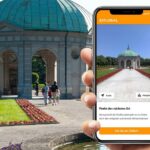
You receive the experience digitally (mobile ticket). The key practical feature is that the game can be accessed offline, which helps you avoid expensive phone data charges. It also makes the experience more reliable when signal is spotty or you’re moving through busy areas.
One thing to plan for: there is no physical tour guide included. That’s not a problem if you’re comfortable using your phone for navigation and following instructions. But if you’re the type who wants someone to read you the story out loud with a microphone, you might prefer a traditional tour.
Start at Odeonsplatz: Leo von Klenze’s Italian-style square and a 1921 clash
Your journey begins at Odeonsplatz, a central square laid out in the early 19th century by Leo von Klenze in an Italian-like style. It’s one of those places where the architecture feels composed and deliberate, which is a nice contrast to the darker scenario the game introduces.
The story checkpoint points to events from 1921, when authorities were waiting with machine guns at Odeonsplatz because of an attempt by an obscure leader of a minor band to seize control of Bavaria. Some people were killed in the fire, and the leader you’re chasing is described as someone who later caused many deaths across Europe.
Practical advice: at this early stop, use a minute to get your bearings. Once you start answering the first challenge, the game rhythm clicks, and you’ll be ready to notice small details at each next location.
Admission note: this stop is marked as free.
Hofgarten: a 17th-century Renaissance garden with a side of secrets
Next comes Hofgarten, the green pocket near Munich’s historic old town. The park was designed in the 17th century by Elector Maximilian I, with an Italian Renaissance garden as a muse. In real life, you’ll see a calm place for walking and lingering—exactly the kind of setting where a dark rumor can feel believable.
The game frames Hofgarten as a place once reserved for high-class personalities like dukes and electors. Today, it’s open to everyone, which changes the vibe: you can slow down, look around, and take in the design without feeling like you’re intruding on someone else’s ritual.
What I like here is that this stop doesn’t just throw spooky words at you. It pushes you to look outward—around benches, paths, and the overall feeling of symmetry—then asks you to keep going with the story.
Admission note: this stop is marked as free.





Theatinerkirche St. Kajetan: white interior, yellow facade, and a clue you earn
Now you’re headed to Theatinerkirche St. Kajetan, a Catholic church erected by Elector Ferdinand Maria and his wife Henriette Adelaide in the mid-17th century. The church was built as a tribute to the birth of the long-awaited heir to the Bavarian throne.
If you only glance from the street, you miss the best contrast. The exterior facade is known for its bright yellow, while the interior is described as white and ornate. That inside-out contrast is a great reason to consider whether you’ll pay to enter, because the game clearly wants you to pay attention to what you see inside.
Practical advice: if you’re short on time, decide early whether you want the inside viewpoint. The challenge here is tied to the church itself, and the game warns not to get stuck admiring only the outside.
Admission note: admission is not included for this stop.
Sitzender Keiler (Sitting Boar): rub the nose, then solve the mystery

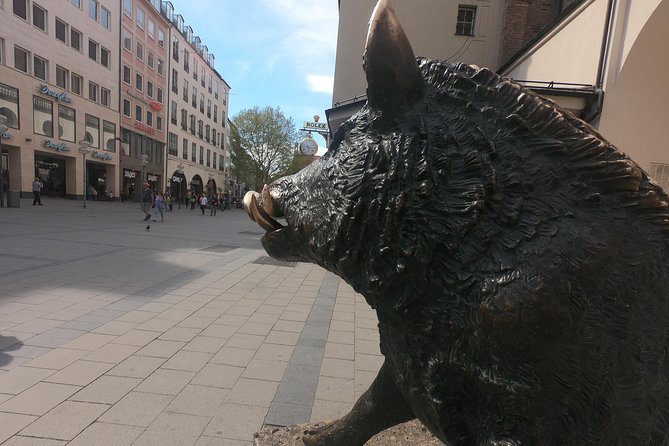
This checkpoint is wonderfully weird in the best way: Sitzender Keiler, also called the Sitting Boar. The statue is at the entrance to the Hunting and Fishing Museum, showing a pig resting on its hind legs, with front legs perched as if it’s watching something.
The game adds an old-school superstition twist: you’re told to go to the statue and rub its nose for luck. Then, the route moves you from charm to mystery—basically, a friendly nudge that turns a quick photo stop into an actual task.
What I like: it’s quick, silly, and memorable. And it breaks the heavier tone of the churches and political legends.
Practical tip: when you approach, slow down and look at the posture. The statue is distinctive, and the challenge style here rewards careful observation.
Admission note: this stop is marked as free.
Frauenkirche: twin towers near 100 meters and the Devil’s footprint legend
No Munich walk feels complete without seeing the Frauenkirche. The game centers you between its two twin towers, each around 100 meters tall. It’s one of Munich’s most recognizable landmarks for a reason, and it’s easy to understand why the route includes it as a major checkpoint.
Inside, the story points you to intricate vaulted ceilings and long stained-glass windows. That sets expectations: this is a stop where architecture matters, and where the game likely wants you to remember specific visual cues.
Then comes the legend: the church entrance has the Devil’s footprint. The builder is said to have made a bet with the Devil that the church would have no windows. When the Devil realized he’d been tricked, he left his footprint at the entrance.
If you do only one paid entry stop, this is a strong candidate. The legend makes you look at the entrance area more carefully, and the interior descriptions are the kind that can reward time.
Admission note: admission is not included for this stop.
Marienplatz: Munich’s central square where stories and schedules overlap
From church to square. Marienplatz is Munich’s main public space and a natural place for people-watching, because events happen here year-round—Christmas markets, city celebrations, and even big football moments like FC Bayern championship celebrations.
The game also anchors Marienplatz in deeper time. It says the area has been central since Munich was founded by Henry the Lion in the 12th century, and that this was where the city’s important streets met. Historically, tournaments were organized here too.
What I like about using Marienplatz as a game checkpoint is that the setting is inherently dramatic. Even if you’re not into legends, the sounds and motion of the square keep the walk from becoming too solemn. You’re moving between spooky beats without feeling like you’re trapped in the dark theme the whole time.
Admission note: this stop is marked as free.
St. Peter’s Church and its 299 steps: Munich’s oldest church
Next is St. Peter’s Church, described as Munich’s oldest Catholic church. The building has survived tragic fires and wars over the last 800 years, and because of frequent reconstructions, you may notice a blend of architectural styles: Gothic, Baroque, and Rococo.
Here’s the practical payoff: the tower visit. The game points out that you’ll get a bird’s-eye view if you climb 299 steps to the tower. This is the kind of effort that can make a self-guided activity feel like a real outing rather than just a walking scavenger hunt.
Consider your energy here. If stairs usually drain you, you might still enjoy the church itself. But if you like viewpoints and don’t mind climbing, this is one of the best places in the route for a payoff.
Admission note: admission is not included for this stop.
New Town Hall (Neus Rathaus): Glockenspiel stories and a dance-style final clue
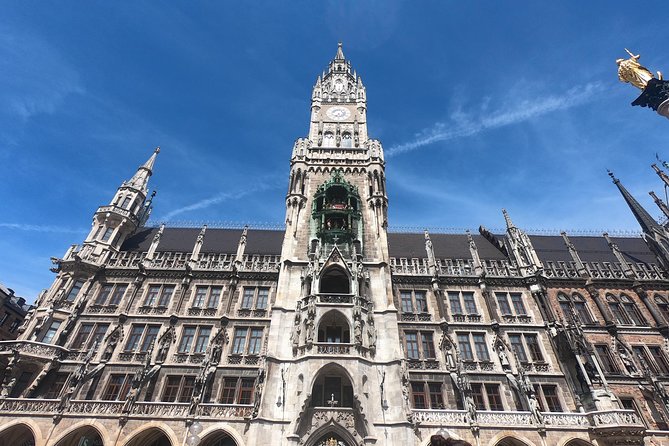
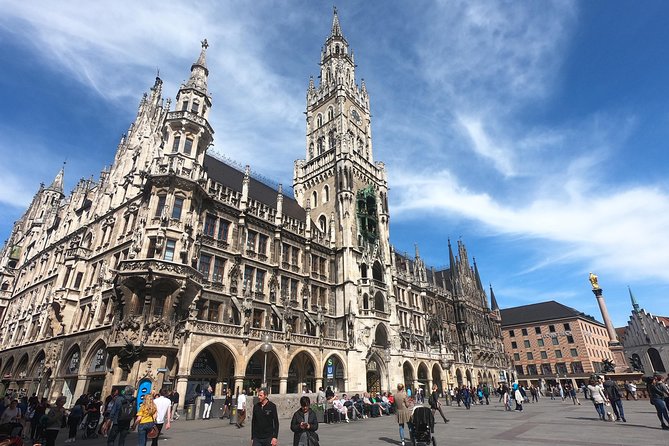
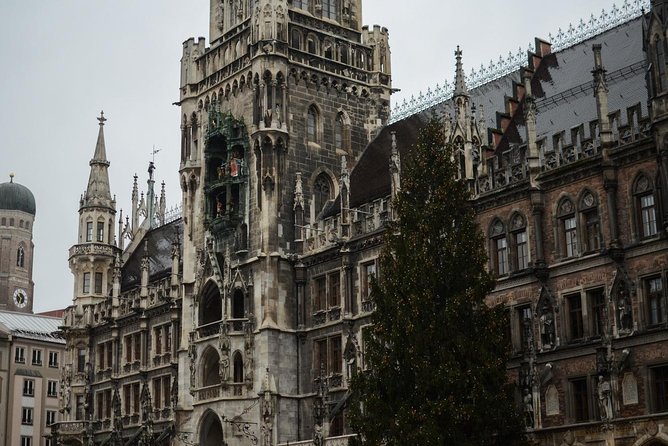
Your last checkpoint is the New Town Hall (Neus Rathaus). The game frames it as home to politics in Munich, where city council meetings take place, and it also notes FC Bayern’s “favorite balcony” tradition—something football fans will recognize instantly.
The big attention-getter is the Glockenspiel. The story here says performances and stories attract audiences from around the world, including a legend about plague fear. After a terrible epidemic, the barrel makers were said to be the first people to risk stepping back out onto the streets, dancing for the amusement of the population gripped by fear of the disease.
Then the game gets you moving. The final instruction is basically to dance your way to the final clue, so you end the route with a playful twist instead of a final museum-like moment.
If you’re traveling with teenagers or anyone who gets restless on tours, this ending can be a win. It’s fun, it’s memorable, and it turns the last stop into a light finale rather than a hard stop.
Admission note: admission is not included for this stop.
Timing, walking pace, and making it feel like your trip
The route is listed at about 1 to 2 hours, which is a sweet spot for a city activity. It’s long enough to feel like you did something, but short enough that you won’t wreck your whole day.
You can start at any time (it’s shown as available essentially all day within the long date range listed). That’s useful because you can avoid peak church hours or plan around meals. The game is also built to let you start, pause, and resume later, which is great if you want to split it into two chunks.
One extra planning note: the experience is booked on average about 12 days in advance. With opening hours shown as very flexible, it’s probably not a last-minute panic situation, but booking ahead still makes sense if your dates are tight.
Finally, keep expectations realistic: you’re walking through central Munich from stop to stop. That’s part of the fun, but it also means comfortable shoes help.
Who should book this game (and who might prefer something else)
This is a strong fit if you want:
- a self-paced experience
- a cheap activity that still gives structure
- an English audio story format
- a way to see Munich landmarks with a “look closer” mindset
It’s also a good family-friendly option in practice. One positive experience shared it worked well with a wife and two teen girls, with a focus on teamwork and observational skills. That makes sense: the game requires you to notice details, then coordinate who solves what next.
It might be less satisfying if:
- you strongly prefer a live guide to explain everything
- you dislike using your phone for instructions
- you expect all fees and entries to be included (some stops aren’t)
And if you run into technical trouble, there’s at least a clear route to help. When something didn’t work for one person, the provider response directed them to email [email protected] for help.
Should you book Ghosts of Munich?
If you’re in central Munich and you want a different way to see famous places, I think this is a smart booking. The biggest reasons: offline audio, flexible timing, and a story that points you to specific Munich landmarks instead of vague “wander and hope” tourism.
Just budget a little attention for the admission-not-included stops. If you want the full impact, plan for at least a couple paid entries such as the churches and the tower climb.
My final take: for the price, the setup is a fun way to turn sightseeing into a light mystery walk. If you like puzzles and don’t mind following instructions on your phone, this is one of those activities that can make a regular day in Munich feel a lot more personal.
FAQ
How much does Ghosts of Munich cost per person?
It costs $7.21 per person.
How long does the experience take?
Plan for about 1 to 2 hours.
Can I use the game offline?
Yes. It can be accessed offline, which helps you avoid phone data charges.
What language is the game offered in?
The experience includes audio stories in English.
Do I need to go with a guide?
No. It’s a private self-guided experience, and a physical tour guide is not included.
Where do I start and where does it end?
You start at Odeonsplatz (Odeonspl., 80 München-Altstadt-Lehel, Germany) and end at Rindermarkt 17, 80331 München, Germany.
Are tickets included for all stops?
Not all. Some stops are marked as free, while others list admission tickets not included.
Can we start at any time and take breaks?
Yes. The experience includes full flexibility to start at any hour, take a break, and resume later. It can be played anytime after booking without rescheduling.
What if I need to cancel?
You can cancel for a full refund if you cancel at least 24 hours before the experience start time. If you cancel less than 24 hours before, the amount paid is not refunded.