REVIEW · WALKING TOURS
Walking Tour on Resistance to Nazism in Munich
Book on Viator →Operated by Explora Múnich · Bookable on Viator
Nazi power changed everyday life fast. This walking tour turns Munich’s landmarks into a clear map of resistance—from political dissent to moral courage. It moves through major sites where people resisted Nazi rule, including the White Rose and the plot of Georg Elser.
What I like most is how the guide connects the story to what you can actually see on the street. And I also love the quality of the explanations—guides such as Laura, Maca, Javier, Jaime, and Julieta are consistently described as friendly, easy to follow, and great at answering questions. The one thing to consider is that this route covers heavy, painful themes, so it may feel emotionally intense.
You’ll cover eight stops in about 2 hours 30 minutes, with roughly 20 minutes at each. It’s not a long, slow museum day. It’s a focused walk with short segments that help you understand what happened—and why resistance took different forms.
In This Review
- Key highlights you’ll feel on the walk
- Why This Munich Resistance Route Feels More Than a Lecture
- Price and Time: What $19.49 Buys in Central Munich
- Start at Odeonsplatz: The Route Begins in Power and Image
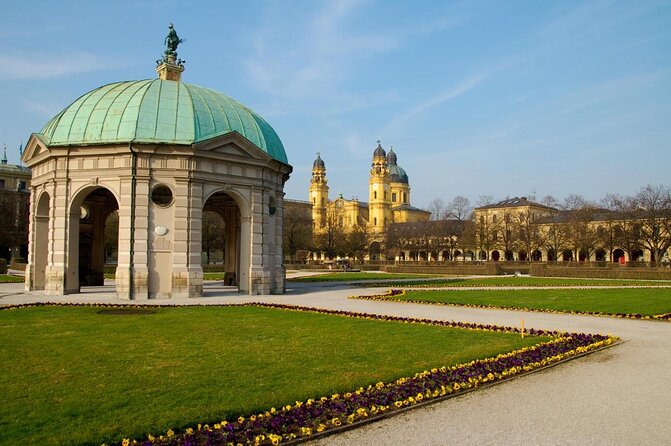
- Stop 1: Hofgarten and Royal Life Under Nazi Pressure
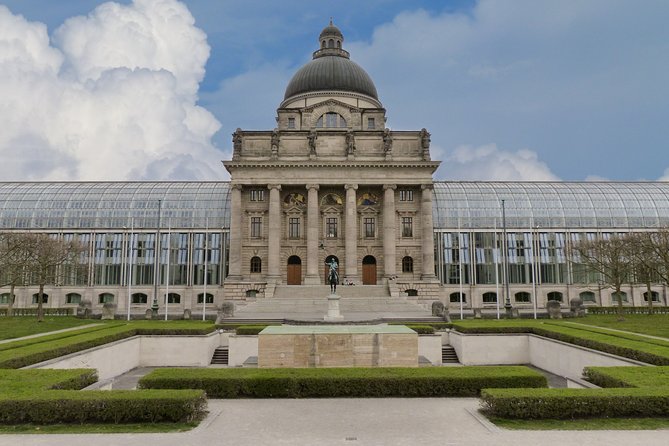
- Stop 2: Bayerische Staatskanzlei and Political Resistance (Sopade)
- Stop 3: Prinzregentenstraße and Resistance Inside the Militia
- Stop 4: Bavarian National Museum and the Valkyrie Operation
- Stop 5: Haus der Kunst and Nazi Censorship Through Art
- Stop 6: Ludwigskirche, Church-State Tension, and Law T4
- Stop 7: DenkStatte Weisse Rose and the White Rose
- Stop 8: Türkenstraße and Georg Elser’s Memorial
- How the Guides Change the Experience (Laura, Maca, Javier, Jaime, Julieta)
- What You’ll Leave With: A Map of Resistance, Not Just Names
- Should You Book This Munich Resistance Walking Tour?
- FAQ
- Where does the tour start?
- Where does the tour end?
- What time does the tour begin?
- How long is the walking tour?
- How much does it cost?
- Is the ticket mobile?
- When will I receive confirmation after booking?
- Is free cancellation available?
- Are admission tickets required for the stops?
- Is the group size limited?
Key highlights you’ll feel on the walk
- Small group pace (max 25 people): enough time for questions without dragging the schedule.
- Guide-driven storytelling: multiple guides (like Laura and Maca) are praised for clear, detailed explanations.
- Free-entry stops: each listed stop has free admission tied to the experience.
- A route with variety: politics, military resistance, art censorship, and church resistance all show up.
- The Munich names that matter: Sopade, Degenerate Art, Law T4, White Rose, and Georg Elser.
Why This Munich Resistance Route Feels More Than a Lecture
Munich can look polished and orderly from a distance. This tour forces you to look again—at facades, institutions, and streets—then connect them to real choices people made under a dictatorship. The goal isn’t just dates. It’s the human question: what do you do when freedom is taken?
I like that the tour follows multiple kinds of resistance. Some people pushed back in politics. Some tried to change things from within institutions. Some refused Nazi propaganda in culture. Some resisted through faith. And some acted in extreme, direct ways. The walk helps you see that resistance wasn’t one single style—it was a spectrum.
And because the guide keeps returning to practical details you can spot around you, the story doesn’t float in the abstract. You’re learning with your eyes open.
You can also read our reviews of more walking tours in Munich
Price and Time: What $19.49 Buys in Central Munich
The price is $19.49 per person for about 2 hours 30 minutes, with a mobile ticket. For Munich, that’s a reasonable value when you compare it to paid museum tickets and private guided time. You’re also not paying for entry along the way—each stop is listed with admission ticket free—so your money goes mostly to the guide and the narrative structure.
Timing matters, too. The tour starts at 3:00 pm, so you’re not fighting the morning rush. It also gives you a good afternoon plan that pairs well with other nearby sightseeing.
One more practical point: this tour is commonly booked well ahead (on average 141 days). If your dates are firm, I’d book early rather than hope for last-minute space.
Start at Odeonsplatz: The Route Begins in Power and Image
You start at Odeonsplatz and finish at Georg-Elser-Platz. That matters because the story is moving west-to-northeast through Munich’s important political and cultural spaces.
At the beginning, the tour sets the tone: Nazi rule didn’t only operate through uniforms and speeches. It also worked through who sat where, who controlled institutions, and how public life looked. The guide’s job here is to get you oriented fast, then keep the thread running through every stop.
If you’re new to this subject, this is a helpful starting point. You’ll quickly learn the big frame—daily life under the regime, the pressure to comply, and the people who chose not to.
Stop 1: Hofgarten and Royal Life Under Nazi Pressure
At Hofgarten, you’ll hear how the royal family lived during the Nazi period and what the political situation looked like. This stop is useful because it reminds you that Nazi power didn’t land in a vacuum. Old systems and elite spaces were involved—sometimes adapting, sometimes shrinking back, sometimes trying to keep dignity while the regime tightened control.
You’ll get about 20 minutes here, so don’t expect a long palace lecture. Instead, think of it as a grounding piece: power, prestige, and what happens when a dictatorship reshapes the entire social order.
Drawback to note: if you prefer deep dives into monarchy or royal history, this part will feel more like a primer than a full chapter. But it sets you up well for the political resistance that comes next.
Stop 2: Bayerische Staatskanzlei and Political Resistance (Sopade)
Next is Bayerische Staatskanzlei, where the focus is on political parties that resisted the Nazi regime—especially the Sopade. This is a big deal because it shows resistance as something that can happen through organization, not just secret plots.
You’ll likely leave this stop with a clearer idea of how dissent could survive even when public opposition was dangerous. Political resistance often looks less cinematic than sabotage, but it’s still real courage. It also helps explain how some resistance efforts stayed connected to networks, communication, and long-term thinking.
If you enjoy political structure—who had authority, who could speak, who had to hide—this is one of the more satisfying stops.



Stop 3: Prinzregentenstraße and Resistance Inside the Militia
At Prinzregentenstraße, you’ll talk about the former Luftwaffe Command Center and discuss resistance within the militia itself. This stop adds a tense, high-stakes layer to the story: sometimes resistance didn’t come from outsiders. It came from people who were inside military structures.
That angle is valuable because it challenges a simple narrative of helplessness. The guide helps you understand that some actors could see what was happening and still choose to resist—at great personal risk.
Again, the time is tight (about 20 minutes). But the payoff is that you now have three resistance “lanes” in your head: political dissent, resistance in institutions, and opposition inside systems tied to war.
Stop 4: Bavarian National Museum and the Valkyrie Operation
At the Bavarian National Museum, the highlight is what happened in the Valkyrie Operation. This is where the tour touches the well-known resistance plotting tied to the Nazi regime’s leadership.
You’ll get a guided explanation that stays practical: what Valkyrie was connected to, why it mattered, and how it fits into the broader story of German resistance movements. Even if you’ve heard the name before, the tour framework helps you place it in the Munich-specific context you’re walking through.
Possible consideration: the tour keeps each stop short. If you want to spend extra time on Valkyrie details, use this stop as the starting point, then plan a later museum session of your own.
Stop 5: Haus der Kunst and Nazi Censorship Through Art
At Haus der Kunst, you’ll learn how Nazism tried to censor art, including the exhibition of Degenerate Art, and how Nazi propaganda controlled the press.
This stop is powerful because it shows resistance in a cultural form. When regimes control what people see, they also control what people can imagine. The tour’s approach helps you connect art censorship to everyday life: propaganda wasn’t confined to posters. It shaped institutions, galleries, and public conversation.
I also love that the guide links propaganda to mechanisms, not just slogans. You start seeing patterns: who decides what is acceptable, how narratives are pushed, and how suppression can be bureaucratic as well as brutal.
Stop 6: Ludwigskirche, Church-State Tension, and Law T4
At Ludwigskirche, the tour explains the relationship between the Church and Nazism, and it covers Law T4 and how religious groups resisted the regime.
This is one of the heavier stops on the route. The tour’s value here is clarity. You’ll hear how legal policy and moral boundaries intersected, and why refusal could come from faith-based institutions and individuals.
If you’re the type who appreciates ethical context—not just political mechanics—this section will stick with you. It also helps balance the route. Not all resistance relied on party politics or military plotting. Some came from moral and religious refusal when laws crossed human lines.
Stop 7: DenkStatte Weisse Rose and the White Rose
Then you reach DenkStatte Weisse Rose, where you meet the best-known resistance group in Munich: the White Rose. This is the stop people remember, and for good reason. The White Rose story is often taught for its message and courage, but the walk format gives it a real sense of place.
This is where the guide’s storytelling quality really matters. The strongest versions of this tour tend to make the group feel personal—like real people made real decisions, not just textbook names. In the feedback you might hear guides like Laura or Maca praised for explaining things from the heart while still keeping details clear and understandable.
If you want a moment to sit with what you’re learning, this is the place to do it. Watch the surroundings, then let the story land.
Stop 8: Türkenstraße and Georg Elser’s Memorial
Finally, you visit the Georg Elser Memorial on Türkenstraße and talk about how attentive action against the Führer’s life became part of the resistance story.
This stop changes the emotional gear. It shifts from groups and movements to a specific act of determination. It also helps you understand that resistance wasn’t only collective. It could be personal, focused, and extremely risky.
Ending at Georg-Elser-Platz gives the walk a satisfying finish point. By the time you arrive there, you’ve covered politics, military resistance, propaganda control, religious refusal, and direct action. That makes the final message feel complete rather than random.
How the Guides Change the Experience (Laura, Maca, Javier, Jaime, Julieta)
The real power of this tour is the guiding style. Across different guide names you may see—Laura, Maca, Javier, Jaime, and Julieta—the pattern is consistent: clear explanation, friendliness, and a real willingness to answer questions.
What that means for you: you won’t just hear a timeline. You’ll get help understanding why people resisted and how each choice fits a larger picture. Several guides are also described as delivering explanations that are easy to follow even if the subject matter is difficult.
A practical tip: come with one or two questions of your own. For example, ask how political parties stayed active under repression, or how censorship worked in everyday culture. The small-group size makes it more likely your question gets a real answer.
What You’ll Leave With: A Map of Resistance, Not Just Names
By the end, you should have more than a list of famous events. You’ll have a mental map of different resistance tracks that operated in parallel:
- Politics pushing back through organization (including the Sopade)
- Resistance inside military structures, connected to command and planning
- Cultural resistance against propaganda via art and controlled media
- Moral and religious resistance tied to law and human rights
- Direct action tied to assassination attempts and decisive intent
That structure matters. People often learn about Nazi Germany as one big dark chapter. This walk gives you a more usable framework: different people resisted in different ways, and Munich’s institutions shaped the struggle.
If you’re planning other history stops afterward, this helps you connect the dots instead of treating each site as separate trivia.
Should You Book This Munich Resistance Walking Tour?
Book it if you want a guided, efficient way to understand Nazi-era resistance in Munich’s real locations. The route is compact, the price is reasonable for a 2.5-hour guided experience, and the guide quality seems consistently strong. The free-entry nature of the stops makes it easy to spend money on interpretation, not admissions.
Skip or think twice if you know you prefer lighter, purely architectural walks. This one deals with persecution, propaganda, and deadly laws. Also, each stop is around 20 minutes, so it’s not built for slow reading or museum-style depth.
If that sounds like your kind of history plan, you’ll likely find this tour a smart use of an afternoon—clear, guided, and grounded in the places where resistance had to happen.
FAQ
Where does the tour start?
It starts at Odeonsplatz (Odeonspl.), 80333 München, Germany.
Where does the tour end?
It ends at Georg-Elser-Platz, 80799 München-Maxvorstadt, Germany.
What time does the tour begin?
The start time is 3:00 pm.
How long is the walking tour?
It lasts about 2 hours 30 minutes.
How much does it cost?
The price is $19.49 per person.
Is the ticket mobile?
Yes, it uses a mobile ticket.
When will I receive confirmation after booking?
You receive confirmation at booking time unless you book within 16 hours of travel, in which case confirmation is sent as soon as possible subject to availability.
Is free cancellation available?
Yes. You can cancel up to 24 hours in advance for a full refund.
Are admission tickets required for the stops?
The listed stops are shown as admission ticket free.
Is the group size limited?
Yes, the tour has a maximum of 25 travelers and is near public transportation; service animals are allowed, and most people can participate.