REVIEW · CITY TOURS
Munich Walking Quiz: Explore and Discover the City’s Highlights
Book on Viator →Operated by Walking Quiz · Bookable on Viator
A quiz that turns streets into clues. In Munich, this Walking Quiz is a smartphone-guided pub quiz that leads you block by block, stopping at places you can actually see and then answering questions tied to that spot. It’s a fun way to learn the city while you walk, not after you get home.
What I like most is the mix of 36 location-based questions across categories like Landmarks, The Famous, Sports, History, and Trivia. I also like that it’s built for small groups: you can play as teams (up to four competing teams), and your points depend on getting answers right as you move.
One thing to consider: it’s more game-format than lecture. If you’re hoping for a long, story-heavy guided tour with lots of spoken commentary, this might feel a bit more like you’re running a quest than getting a traditional tour.
In This Review
- Quick highlights: what makes the Munich Walking Quiz work
- Marienplatz as your game board
- How the quiz is structured: categories, points, and a clear finish line
- What you’ll learn from the Landmarks stops
- The Famous: Munich personalities you might not expect
- Sports questions that make you slow down
- History, but through the lens of where you are
- Trivia: the category that can steal the win
- Smart phone navigation: why the app matters more than you’d expect
- The route rhythm: what your three hours feel like
- Who this is best for (and who might want something else)
- Value: how $42.82 per group makes sense
- Practical tips to make your score and your walk both better
- Should you book the Munich Walking Quiz?
- FAQ
- FAQ
- How long is the Munich Walking Quiz?
- Where does the Walking Quiz start?
- Does the tour end back at the start?
- How much does it cost?
- How many questions are included?
- What kinds of topics are the questions about?
- How do I answer the questions?
- Do I need a smartphone?
- Is this activity private?
- Are service animals allowed?
- What is the cancellation policy?
Quick highlights: what makes the Munich Walking Quiz work

- 36 pub quiz questions spread across multiple categories, with clear rules for finishing
- Smartphone map navigation that tells you where to go for each question location
- Marienplatz start and finish, so it’s easy to anchor your day in the historic center
- Team play for up to four competing teams, great for families and friends
- Questions tied to where you are standing, which helps facts stick
- Max four hours, so you can fit it into a normal sightseeing afternoon
Marienplatz as your game board
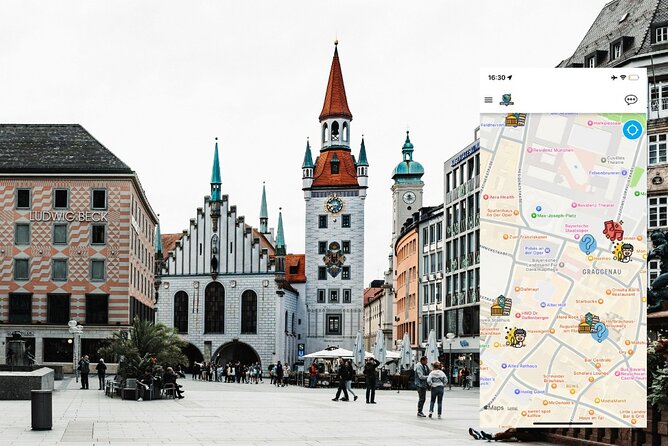
You begin at Marienplatz, Munich’s central square and the natural starting point for first-time visitors. The best part here is simple: you’re already in a spot you’ll recognize, and you don’t waste time figuring out where the experience actually starts.
The quiz then unfolds as a walking route you follow using your phone. You’ll navigate to a location shown on the map in the app, answer the question, and then get your next target. There’s no need to memorize directions ahead of time because the app is doing the routing.
This format is especially good if you get decision-fatigue when you travel. You just focus on the next move: walk, scan, answer, repeat. When you’re done, you wrap back at Marienplatz.
You can also read our reviews of more walking tours in Munich



How the quiz is structured: categories, points, and a clear finish line
This is not a random trivia stroll. It uses a structured pub quiz system with defined categories and a finish goal. You’ll face 36 total questions, arranged into six categories, including Landmarks, The Famous, Sports, History, and Trivia.
Each category has six questions, but the scoring logic matters. To complete a category, a team must answer three questions correctly from that category. That’s a relief if you’re not a trivia wizard, because you’re not required to get everything right perfectly from the start.
Your overall goal is straightforward: be the first team to finish all categories. As you get correct answers, you earn points, and the first team that completes everything wins the race against the clock.
One practical result of this structure: the game stays readable. You’re not constantly guessing whether you’re doing well. You can usually tell if your team is on track to clear a category.
What you’ll learn from the Landmarks stops
The Landmarks category is where your eyes do most of the learning. Since each question is tied to a specific location you’re guided to, you’re not just reading facts you can’t place. You see the spot, then you’re asked something about it, and the context locks in faster.
I like this approach because it turns photo stops into learning stops. Munich has enough iconic sights that it can be easy to take pictures without remembering names. This forces you to look closely enough to connect the answer to the place in front of you.
If you’re the type who usually skims history, you’ll still get traction here. The questions are designed to be doable while you walk. The app helps you move through the city in a way that nudges you toward the right viewpoints.
The one drawback: because the questions are location-based, your learning is tied to what the route actually hits. If you already know every landmark in Munich, you may recognize some of the answers fast and feel the challenge shift toward the trivia side.
The Famous: Munich personalities you might not expect
Next comes The Famous category, which points you beyond monuments and into people and stories. This is the kind of section that’s handy when your visit is short and your reading list is long.
The value here is that it pushes you to notice that Munich’s identity isn’t only architecture. It’s also the people associated with the city, and the “famous” layer can help you connect what you see to larger themes like culture and public life.
From what people say about the concept, the best moments are when you’re standing near the place connected to the question. That makes the information feel earned, not memorized.
If you’re a deep Munich historian, you might want even more detail than the quiz provides. But for most visitors, this category hits the sweet spot: enough context to spark interest, without turning your afternoon into a classroom.
Sports questions that make you slow down
Sports shows up as its own category, and that’s a smart choice in a city where athletics are part of the everyday identity. While you’re walking, the questions encourage you to pay attention to Munich’s sporting culture rather than just the obvious tourist agenda.
What’s useful for you is that sports trivia often leads to easier follow-up on your own. Once you learn a couple facts during the game, it’s simpler to decide what to read or what to see later.
The tradeoff is timing. Sports questions can be tougher if you don’t follow German leagues. The good news is the scoring system: you only need three correct answers per category to complete it, so you’re not stuck if one topic doesn’t click right away.
You can also read our reviews of more city tours in Munich






History, but through the lens of where you are
The History category is where the quiz can feel most rewarding. It’s not presented like a long lecture. Instead, each history question is anchored to a place the app takes you to.
That location-first method is exactly what helps you remember. You’re building a mental map: this street connects to that idea, that building connects to that story. Over the course of a route, Munich starts to feel more like a connected story than a list of sights.
One practical tip for your team: don’t rush through history questions. If you’re standing in the right area, you often pick up clues from what’s around you. Even when you’re guessing, the process of looking helps you get closer to the answer.
Trivia: the category that can steal the win
Trivia is the category that can swing results. Some questions can be tougher, and that’s part of the fun. If your group likes puzzles, you’ll enjoy how the trivia category tests memory, recognition, and fast decision-making.
I recommend having one person be the “answer driver” while the rest of the team acts like a quick brainstorming panel. That keeps things moving when the question feels tricky and you’re trying to avoid the slow group debate spiral.
Also, if you’re competitive, set expectations early. A team can feel ahead early and then lose ground when trivia ramps up. That’s why the category completion rule matters: you still have a path to finish even if one section is harder.
Smart phone navigation: why the app matters more than you’d expect
The core mechanic is navigation by smartphone. The app shows you a question location on a map, and you have to go there to answer. It’s designed to run on iOS or Android, which is ideal for most visitors traveling with modern phones.
I like this because it makes the city feel interactive without requiring a guide to talk nonstop. You’re still in control of your pace, and the app gives structure so you don’t wander aimlessly.
You should also expect that you’ll keep checking the screen as you walk. That means comfortable shoes matter. It’s a walking activity, and you’ll be moving between points for about 3 hours on average (with a maximum time limit of up to four hours).
One thing to plan around: if your phone battery is low, charge before you start. Since you’re using the map throughout, a dying battery can turn a fun game into an annoying scramble.
The route rhythm: what your three hours feel like
Even without a traditional stop-by-stop guided itinerary, the experience has a rhythm. You keep walking from one answer point to the next, and the app steadily progresses you through the categories.
Most people experience it like an afternoon activity. It’s long enough to feel like you saw more than just the basics, but it’s not so long that you’re cooked for the rest of the day.
Because you start and end at Marienplatz, it’s easy to connect it with other plans. You can eat before you begin, and you can regroup afterward without complicated logistics.
If you’re traveling with kids, the game format can help with attention spans. One of the most appealing aspects is that you’re always working toward the next question instead of sitting still.
Who this is best for (and who might want something else)
This Walking Quiz is a great fit for:
- Small groups and families who want an activity, not just sightseeing
- People who learn faster when facts are tied to a place
- Friends who like friendly competition and clear rules
It’s also handy if you’ve already done the classic “big attractions” and you want something that adds structure to a lighter day.
If you’re a traveler who wants a slow, narrative guide explaining every sight in depth, you may find the game format too light on spoken context. The app handles direction; it doesn’t replace a deep conversational guide. Think of this as a city game you play while walking, not a full commentary tour.
Value: how $42.82 per group makes sense
The price is $42.82 per group, up to four people. On a per-person basis, that can be a lot easier to swallow than many paid guided experiences, especially when you have enough people to fill the group.
The real value comes from what you’re getting for that time:
- A structured experience lasting around 3 hours
- A smartphone-driven route that handles the flow for you
- A total of 36 questions across multiple subjects
- Team competition that keeps the energy up
If you’re traveling alone, it can still be fun, but you won’t get the group-cost advantage. If you’re a couple, it can still feel reasonable, but it shines most when your group is close to four and you can truly play as teams.
Practical tips to make your score and your walk both better
Here are a few things that help you enjoy the day more, regardless of how competitive you are:
- Bring headphones if you use them, but keep your attention available for the map prompts.
- Form roles in your team: one person watches the app, others answer quickly.
- Use comfy shoes; you’re walking between question locations.
- Plan phone battery; the app is central to navigating and answering.
- Expect some tougher trivia, and don’t let one question derail the category streak.
Also, keep your expectations realistic. The game is designed to be doable, but it’s not meant to be effortless. That balance is part of why it works as a “fun afternoon” activity.
Should you book the Munich Walking Quiz?
If you want a playful way to learn Munich while you walk, this is an easy yes. The smartphone map setup reduces the stress of navigating, and the 36 questions give your day a structure that plain wandering usually lacks. It’s especially worth booking if you’re traveling with family, or if your group likes light competition and learning through doing.
Book it if your ideal Munich day has a rhythm: show up at Marienplatz, follow app directions, answer questions tied to the places you see, and finish back where you started. Skip it only if you’re specifically after a talk-heavy guided tour with lots of narrative explanations. In that case, you’d likely prefer something more traditional.
FAQ
FAQ
How long is the Munich Walking Quiz?
It lasts about 3 hours on average. The game has a maximum time limit of up to four hours.
Where does the Walking Quiz start?
The start location is Marienplatz, 80331 München, Germany.
Does the tour end back at the start?
Yes. It ends back at the meeting point.
How much does it cost?
It costs $42.82 per group (up to 4).
How many questions are included?
There are 36 pub quiz questions total.
What kinds of topics are the questions about?
The quiz covers categories including Landmarks, The Famous, Sports, History, and Trivia.
How do I answer the questions?
You have to navigate to a location shown on the smartphone map through the app, then answer the question at that spot.
Do I need a smartphone?
Yes. The game uses a smartphone app compatible with iOS or Android.
Is this activity private?
Yes. It is a private tour/activity, so only your group will participate.
Are service animals allowed?
Yes, service animals are allowed.
What is the cancellation policy?
You can cancel for a full refund up to 24 hours in advance of the experience’s start time. If you cancel within 24 hours of the start time, the amount paid is not refunded.